Practice
Artist Statement
I paint the way weather moves — in layers, without a fixed plan, until the surface holds something I recognise from the natural world but could not describe in words.
I grew up beside water in New Zealand, and I think that is where all of this begins. Not with a view I want to reproduce, but with a memory of movement: tide pulling over stone, light changing three times in an afternoon, a colour that only exists for a few minutes. My work is an attempt to hold that, rather than illustrate it.
I work intuitively. A painting usually starts with a single colour decision and very little else. From there I build with heavy-bodied paint and inks, pouring, tilting and layering until the surface begins to behave in a way I did not expect. That moment — where the material takes over — is the one I am waiting for. It is also the reason I rarely sketch a work in advance.
Texture matters to me as much as colour. I want a painting to be physical: ridges you can read from across a room, pooled ink that catches the light, small fissures where two layers dried at different speeds. Some passages I seal and gloss so they behave like water. Others I leave open and matte so they breathe. A work should look different in morning light than it does in the evening.

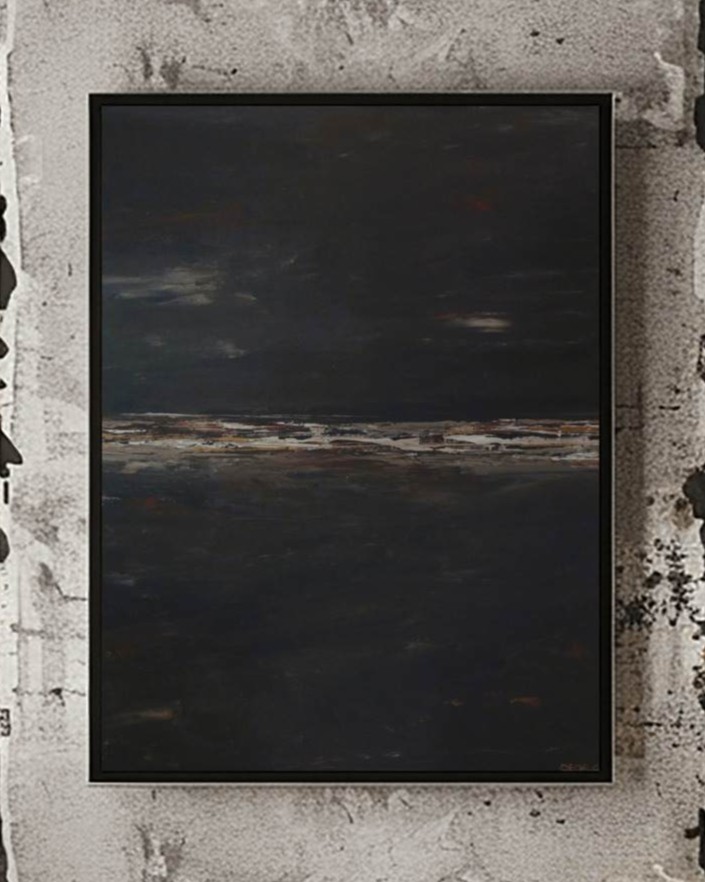
I let work evolve slowly. Paintings are turned to the wall and returned to weeks later; whole passages are removed because they were merely competent. Working in series helps — one canvas answers a question the last one raised, and the collection is finished when the questions stop. I have learned to trust that timing rather than force it.
My background in fashion design is still in everything I make. It taught me how material behaves, how colour reads at a distance, and how much a small, precise detail can change the whole. It also taught me restraint: knowing which decision to leave alone.
What I hope for, finally, is a quiet kind of recognition. Not "that is a coastline", but the feeling of standing near one. If a work continues to reveal something a year after it has been hung, it has done what I asked of it.